How to Improve Focus: Brain Exercises for Adults With ADHD

Have you ever sat down to pay your bKash bill, and three hours later, you’re deep into a YouTube rabbit hole about how rickshaws are painted? Somehow, you completely forgot to pay the bill, and now you have a newfound obsession with Old Dhaka art. You have no idea how you developed a liking for rickshaw art when you just wanted to pay your electric bill.
Well, if this sounds familiar, you might have ADHD, where your brain has 47 tabs open, and you have no idea which one is playing music.
ADHD is a condition where your brain simply refuses to focus on what it’s supposed to, and instead goes on its own little adventure without asking your permission.
At present, roughly 3-8 out of every 100 people on the planet have ADHD, so it’s far from rare, even if it’s unheard of in Bangladesh.
But here’s the thing: having ADHD doesn’t mean you’re broken, lazy, or incapable. It just means your brain works differently. And just like any muscle in your body, your brain can be trained. So the real question is, can you actually teach a wandering brain to focus? The answer is yes. It’s not about willpower; it’s about biology. Research into cognitive remediation proves that targeted mental exercises can physically strengthen the neural pathways responsible for focus, helping you ignore the noise and stay present.
Why your brain acts like a toddler in a toy store
To fix the focus, we first have to understand the hardware. In the brain of an adult with ADHD, the executive functions, the CEO of your brain, are a bit underfunded. Understanding how Executive Function skills in ADHD work is the first step to managing them. This part of the brain is responsible for working memory, impulse control, and shifting attention. When you have ADHD, your brain is constantly hunting for dopamine, the “reward” chemical. If a task isn’t providing a hit of dopamine (like a boring spreadsheet or a utility bill), your brain physically struggles to stay engaged.
However, thanks to a concept called neuroplasticity, your brain is not set in stone. Research on exercise and brain health shows that you can actually build new neural pathways. By engaging in targeted brain exercises to improve memory and focus, you are essentially giving your “inner CEO” a better toolkit to manage the chaos.
Start using ADHD brain exercises to finally find your focus
Before we dive into the “how,” let’s talk about the “what.” Unlike a gym workout where you lift weights to grow a bicep, brain exercises for adults are designed to strengthen the neural pathways between your prefrontal cortex (the decision maker) and the rest of your brain.
If you have been looking for how to exercise your brain, you need to understand that consistency is more important than intensity. You don’t need a 2-hour session; you need 5-minute “sprints” throughout the day. These exercises fall into three main categories:
- Cognitive Training: Improving memory and logic.
- Sensory Grounding: Pulling your mind back from a “rabbit hole.”
- Stimulation Regulation: Managing your need for movement.
By practicing these regularly, you’ll notice the benefits of exercise on the brain, specifically, an increased ability to “catch” yourself before you get distracted.
1. The Reverse Sequence Challenge
This is one of the most effective ways to sharpen your working memory. Working memory is like a mental scratchpad. For people with ADHD, that scratchpad is often full of scribbles or keeps disappearing.
The Exercise: Ask a friend to say a string of five random numbers. Your job is to say them back in reverse order. If they say 8, 3, 1, 9, 5, you have to say 5, 9, 1, 3, 8. As you get better, move up to six or seven digits. This forces your brain to hold information and manipulate it simultaneously, which is exactly the skill you need when trying to follow a complex set of instructions at work.

Why This Works for the ADHD Brain
This exercise is essentially a high-intensity workout for your prefrontal cortex. When you repeat numbers forward, you are using simple recall. But when you reverse them, your brain has to perform two difficult tasks at once:
- Maintenance: Keeping the original numbers from fading away.
- Processing: Mentally rearranging the sequence while resisting the urge to just say them in the order you heard them.
2. The Five Senses Grounding Technique
Distraction often happens because we are living in the future (worrying about a deadline) or the past. Grounding brings you back to the “now.”
The Exercise: Stop what you are doing and identify:
- 5 things you can SEE: Look for small details you usually ignore. The texture of the wall paint, the way the light reflects off your phone screen, or the specific shade of green on a nearby plant.
- 4 things you can TOUCH: Engage with the textures around you. The cold metal of your watch, the rough fabric of your jeans, the smooth surface of your desk, or even the feeling of your feet pressed firmly against the floor.
- 3 things you can HEAR: Listen beyond the obvious. Can you hear the low hum of the air conditioner? The distant sound of traffic outside? The sound of your own rhythmic breathing?
- 2 things you can SMELL: This one is tricky but powerful. Maybe it’s the faint scent of coffee, the smell of your own perfume or detergent, or even just the “dusty” smell of a stack of papers.
- 1 thing you can TASTE: Focus on the lingering taste of your last meal, or simply the neutral taste of the inside of your mouth.

Why This is a Game-Changer for ADHD
For an ADHD brain, the “CEO” (the prefrontal cortex) often struggles to maintain order. This exercise works because it uses sensory input to bypass the internal chatter.
- Reduces Cognitive Load: By focusing on concrete, physical data (like a smell or a sound), you stop the “spinning” of abstract thoughts.
- Interrupts Hyper-fixation: If you are stuck in a “YouTube rabbit hole” or an unproductive thought loop, the 5-4-3-2-1 method breaks the cycle by demanding a total sensory shift.
- Regulates the Nervous System: ADHD often comes with a heightened “fight or flight” response. Grounding signals to your brain that you are safe in your current environment, which lowers your heart rate and clears the mental fog
3. Dual Tasking (The Good Kind)
We are often told multitasking is bad, but for ADHD adults, “stimulation regulation” is key. Sometimes your brain needs a “fidget” for the background so the foreground can focus. This falls under the category of brain exercise games you can play with your environment.

How to implement it:
- Auditory Layering: Use “colored” noise. While white noise is common, many ADHD adults find Brown Noise (deeper, like a low roar or heavy rain) or Pink Noise more soothing. Alternatively, try “Video Game Soundtracks”, they are specifically designed to be engaging without being distracting, keeping you in a “flow state.”
- Kinesthetic Movement: Use a standing desk or sit on an exercise ball. If you have to sit in a meeting or read a long report, try a silent fidget spinner or even “foot tapping.”
- The “Balance” Trick: If you are reading something particularly dry, try standing on one leg. The micro-adjustments your brain has to make to keep you balanced act as a “tether,” preventing your mind from drifting away from the text.
Why This will help you: The Low-Dopamine Threshold
Research on exercise and brain health proves that your brain is plastic. You are not stuck with the “focus level” you have today. In an ADHD brain, the threshold for boredom is much lower because of lower levels of available dopamine. If a task is “under-stimulating,” your brain essentially falls asleep or starts “channel surfing.”
By adding a secondary, low-stakes task, you are effectively:
- Closing the Back Door: You are giving the “distractible” part of your brain something to do so it doesn’t go off and find something more disruptive.
- Increasing Arousal: The small amount of extra effort required to balance or listen to rhythmic beats raises your brain’s overall level of alertness.
- Reducing “Friction”: It makes the primary, “boring” task feel less painful because your sensory needs are being met simultaneously.
4. Visualization and Mental Mapping
ADHD often comes with “time blindness.” We struggle to see the steps required to finish a task, so we get overwhelmed and quit.
Seeing the Finish Line: Visualization and Mental Mapping
For many adults with ADHD, the biggest hurdle isn’t the work itself, but the starting. This is often due to “Executive Dysfunction,” where the brain struggles to sequence the steps of a task. When you look at a messy room or a blank report, your brain doesn’t see a series of small, manageable actions. It sees a giant, overwhelming wall. This leads to “ADHD Paralysis,” where you end up staring at your phone for two hours because you don’t know where the first “brick” is.
Visualization and mental mapping are techniques that use your brain’s powerful visual center to “pre-load” the task, making the transition from rest to work much smoother.
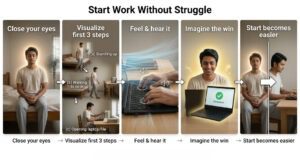
How to do it:
- Close your eyes: Eliminate external visual noise.
- The “Micro-Step” Movie: Don’t just visualize the finished product. Visualize the first three physical movements. See yourself standing up, walking to the desk, and opening the specific file you need.
- Sensory Detail: Imagine the sound of the laptop fan or the feeling of the keyboard under your fingers.
- The “Emotional Win”: Briefly visualize the feeling of relief or the dopamine hit you will get once that specific sub-task is checked off.
Why This Works: Bridging the “Intention-Action” Gap
In an ADHD brain, the connection between “knowing what to do” and “actually doing it” is often frayed. Visualization works because:
- Reduces Cognitive Friction: By “watching” yourself do the task in your mind, your brain creates a memory of the action before it even happens. When you actually go to do it, your brain feels like it is repeating a known path rather than forging a new one.
- Tackles Time Blindness: Mental mapping forces you to acknowledge how long a task actually takes. By visualizing the steps, you realize that “cleaning the kitchen” is actually “putting five plates in the dishwasher,” which feels much more doable.
- Lowers Anxiety: Most procrastination is actually anxiety in disguise. Seeing yourself successfully navigate the first few
You’ve started the work and we will help you finish it
While daily drills and puzzles for brain exercise are a great start, true transformation requires a structured approach. You might have tried free brain exercise apps or searched for free online brain exercises, but these often lack the personalized strategy needed for the neurodivergent brain. This is where professional guidance makes all the difference.
Brain Forward is a pioneer in providing specialized support for the neurodivergent community in Bangladesh. They understand that the traditional “one size fits all” education system doesn’t work for everyone. Their courses are specifically designed to help adults with ADHD move from a state of constant overwhelm to a state of controlled focus.
Through the Brain Forward curriculum, you don’t just learn “productivity hacks.” You engage in evidence-based cognitive training that targets the root of ADHD challenges. Whether you are a professional struggling to meet deadlines or a student who can’t seem to start their thesis, their courses provide the structure and community support you need. Connect with Brain Forward today.