3 Simple Science-Backed Exercises for Anxiety Relief That Really Work

3 Simple Science-Backed Exercises for Anxiety Relief That Really Work
Suppose you lie awake at night thinking about things you can’t control. The next morning, you wake up tired, distracted, and already worried about the day ahead. And the worst part? It can seriously affect your daily life.
But the good news is that you don’t always need medicine to find relief. Research shows that simple, natural techniques can calm your mind and body faster than you’d expect.
Feeling anxious is a normal human response to stress. But the problem starts when it takes over your daily life.
That’s exactly why we discuss 3 science-backed brain exercises here that you can do anywhere, anytime, and they actually work.
Breaking Down Anxiety & Its Effects on the Body
Before we get into the brain exercise, it helps to understand what is actually going on when people face anxiety.
Anxiety is your body’s natural alarm system. When your brain senses a threat, whether real or imagined, it triggers the “fight or flight” response. Your heart beats faster, your breathing gets shallow, your muscles tighten, and stress hormones like cortisol and adrenaline flood your system.
When anxiety becomes chronic, this constant state of alertness starts wearing your body down. These symptoms vary from person to person and often include a rapid heartbeat, sweating, difficulty concentrating, and sleep disturbances. This happens because your nervous system stays on high alert, preparing your body for a threat that is not actually present.
3 Simple Science-Backed Mindfulness Brain Exercises for Anxiety Relief
For these techniques, you don’t need a yoga mat, a meditation app, or an hour of free time. These 3 brain exercises can be done anywhere, anytime, like during your lunch break, before a stressful meeting, or when you wake up at 3 AM with your mind full of thoughts.
So, let’s find out the reason why these exercises actually work and how you can do them.
1. The 4-4-4 Box Breathing Exercise

You’ve probably heard someone say “just breathe” when you’re anxious. It sounds too simple, right? But there is a solid science behind it. Box breathing, also called square breathing, is a technique used by students, athletes, and people of all ages who want to stay calm under pressure. This process can absolutely work for everyday anxiety.
The process is simple. Your breath directly influences your nervous system. Research consistently shows that controlled breathing lowers heart rate, reduces cortisol levels, and calms the mind within minutes.
How to do it:
- Sit comfortably and close your eyes if possible.
- Breathe in slowly through your nose while counting to 4.
- Hold your breath for 4 counts.
- Then slowly through your mouth for 4 counts.
- Hold at the bottom (empty lungs) for 4 counts.
- Repeat the cycle 4 to 6 times.
Think of it like tracing the four sides of a box, like breathe in, hold, breathe out, hold. Each side is 4 seconds. Most people feel noticeably calmer after just two or three cycles. Try it the next time when you feel anxious.
2. The 1-5 Finger Exercise
This brain exercise is really simple, and it works faster than you think.
When you face anxiety issues, your mind stops living in the present. You start replaying old conversations, worrying about future problems, or imagining the worst possible outcomes. Your brain gets so caught up in those thoughts that it forgets where you actually are right now.
So this exercise solves that problem. It brings your attention back to the present moment by using your five senses. And here is the key thing to understand: your brain cannot feel fully anxious and fully present at the same time. When you focus on what is around you right now, the anxiety starts to lose its grip.
Also, this exercise basically gives your brain something real and calm to focus on, which helps break the cycle of anxious thinking. For this, you don’t need any complicated steps or any special skills. Just need your five fingers and a few minutes.
How to do it:
Step 1. Raise only your index finger on your right hand, keeping the rest of your fingers closed inside, just like in the picture shown.
Step 2. Now close your hand into a fist and bring it back in.
Step 3. Now open all five fingers and bring them forward just like the picture shown.
Step 4. Repeat steps 1 to 3 for 10 to 20 times.
Step 5. Now raise only the index finger on your left hand and keep it straight.
Step 6. Now open all five fingers just like the picture shown.
Step 7. Repeat steps 5 to 6 for 10 to 15 times.
Step 8. Now bring your right hand forward with all 5 fingers open and your left hand with only 1 finger raised. Then switch them back and forth.
Step 9. Now do the opposite. Bring your right hand forward with only 1 finger raised and your left hand with all 5 fingers open. Switch them back and forth.
Step 10. Repeat steps 8 to 9 for 10 to 15 times.
This technique works especially during panic moments. It doesn’t make the problem go away, but it gives your nervous system a chance to reset. To better understand this exercise, follow the book – “ব্রেইনের ব্যায়াম”
3. Deep Diaphragmatic Breathing Exercise
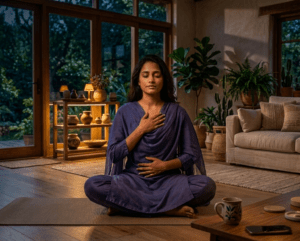
Most people, especially when they feel anxious, breathe from their chest without even realizing it. This kind of shallow, rapid breathing actually sends a danger signal to your brain and keeps your stress response going.
Diaphragmatic breathing, which simply means breathing from your belly, does the complete opposite. It tells your brain that you are safe and that everything is okay.
According to research, this type of breathing lowers cortisol levels, reduces blood pressure, and helps your nervous system calm down more effectively. It is one of the most widely recommended breathing techniques for people dealing with anxiety and panic. The best part is that you can do it anywhere, and it takes only a few minutes.
How to do it:
- Sit or lie down in a comfortable position.
- Place one hand on your chest and one hand on your belly.
- Breathe in slowly through your nose for about 4 seconds. Your belly should rise, not your chest. The hand on your belly should move out. And the hand on your chest should stay mostly still.
- Breathe out slowly through pursed lips for 6 seconds, let your belly fall.
- Repeat for 5 to 10 minutes.
It might feel strange at first if you’re not used to breathing this way. That’s completely normal. Practice it for a few minutes each day, and it will start to feel more natural.
Making Mindfulness Stick
Learning these exercises is the easy part. But the difficult part is actually using them when someone faces anxiety issues.
Consistency matters more than anything else. Five minutes of exercise every day is far better than one hour once a week. The more regularly you practice, the faster your nervous system learns to calm down.
From the beginning, pick just one exercise. You can try box breathing in the morning or the finger exercise before bed. Keep it simple and do it regularly.
Some days, these exercises will make a big difference. Other days, nothing will feel like it is working, and that is completely okay. You are not doing anything wrong. You are simply training your nervous system, and that takes time.
The Science Behind Mindfulness and Anxiety
These exercises are not just a normal technique to reduce anxiety. There is real science behind them.
A 2023 study published in Frontiers in Public Health found that mindfulness-based exercises significantly reduced anxiety, stress, and depression among participants. Other research shows that regular practice actually changes how your brain responds to stress over time.
With regular practice, you also start noticing what is happening inside your own body. This is important because when you feel stress building early, you can use one of these exercises before it gets too strong.
So, the goal is not to get rid of anxiety forever. The goal is to change how you handle it.
FAQ
Which technique is best for beginners?
Ans: Diaphragmatic breathing and the 4-4-4 Box Breathing Exercise are the easiest starting points. Both are simple to learn, completely safe, require no equipment, and can be done anywhere, anytime.
Should I tell my therapist about these exercises?
Ans: Yes, absolutely. Share these with your therapist if you’re working with one. They can help you figure out which techniques suit your specific situation and may combine them with other approaches for even better results.
How do I reduce anxiety immediately at home?
Ans: Try the 4-4-4 box breathing exercise. It works within minutes. Or splashing cold water on your face, and doing a few slow jumping jacks can also help discharge the tension that anxiety builds up in your body.
Does vitamin D deficiency cause anxiety?
Ans: Yes, there is some connection. Low vitamin D levels are linked to increased anxiety and depression. Research suggests vitamin D helps regulate mood in the brain. So ask your doctor for a simple vitamin D blood test.

Always Remember that Your Anxiety Doesn’t Have to Control You
Living with anxiety is exhausting. But the good news is that now you already know everything you need to start feeling better. These 3 simple brain exercises are your starting point. On the other hand, if you want to know more about different types of exercise or brain training courses, then visit Brain Forward and get all the information about your brain condition.
Do not wait for the perfect moment. Start today with just one exercise. Practice it for a few minutes and see how your body responds. Some days will feel easier than others, and that is completely okay.
Progress is not always loud. Sometimes it is just a little calmer than yesterday. And that is more than enough.